| MadSci Network: Cell Biology |
You question (why chromosomes decondense and the nuclear envelope reforms during interphase II of meiosis in some (but not all) organisms) has not been well studied - at least as far as I can tell from a search of PubMed. |
For example, it is not clear from the literature whether any genes are actually expressed during interphase II, and if there are, whether any have specific functions during that period. In the mouse, transcription appears to be suppressed during meiotic maturation (see here and here). There is evidence (see here) that protein synthesis is required for exit from interphase II, but this is likely to be due to the need to synthesize new cyclins, following their degradation after metaphase I. As you note, some organisms have essentially deleted interphase II altogether. |
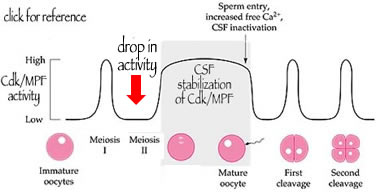
| The reformation of the nuclear envelope and the (at least partial) decondensation of the chromosomes are therefore likely to be due to differences in the timing of the activity of Cyclin-dependent kinase (Cdk)(maturation-promoting factor/MPF) activity. |
Cdk activity mediates both chromosome condensation, spindle formation, and nuclear envelope disassembly (through many target proteins). The destruction of the Cdk-regulatory protein cyclin leads to exit from metaphase I. Where the drop of activity lasts for a long time, chromosomes would be expected to decondense and the nuclear envelope should reassemble. Both would reversed as cyclin levels recover. If the drop in Cdk activity is short, the meiotic cell would be expected to go directly into meiosis II. |
Try the links in the MadSci Library for more information on Cell Biology.