| MadSci Network: Physics |
There are many sources which provide the answer to your question, such as the book "Optics" by Eugene Hecht, or the book "Fundamentals of Optics" by Jenkins and White, but the book I like the most is "The Feynman Lectures on Physics". The appropriate chapter is 33, and the section is 33.6.
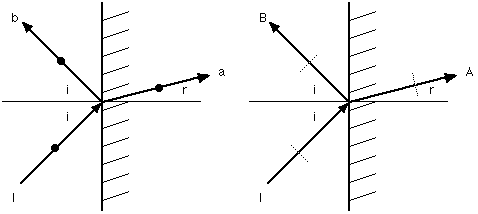
See the figure here.
The left part of the figure shows EM radiation that is polarized
perpendicular to the plane of the page (thus the dots), while the right
side shows EM polarized parallel to the plane of the page. The letters I,
a, b, A, and B are the amplitudes of the EM radiation. As usual the
letters i and r represent the angles of incidence (and reflection, of
course!) and refraction. The material on the left of the interface has
refractive index n1 and on the right of the interface has refractive index
n2. As usual,
n1 sin( i ) = n2 sin( r )
I will not go through the derivation, as that is given in the reference.
The results are
b = - sin( i - r ) / sin( i + r )
B = - tan( i - r) / tan( i + r )
where, I say again, the b and B are amplitudes. To obtain reflection coefficients (which are based on energy, not amplitude of EM) these amplitudes need to be squared. Remember that the intensity is the square of the amplitude of EM.
You will have to determine the refractive index of water at the wavelength of interest, and use the first equation to determine r, and then use the other equations to determine a, b, A, and B.
If we assume the incident light has amplitude 1 (which we can do by
normalizing everything to the incident light!) then
a = sqrt( 1 - b^2 )
A = sqrt( 1 - B^2 )
where "sqrt" is the square-root function and " ^ " denotes exponent, and, again, the intensities on which the reflection and refraction coefficients are calculated are the square of the amplitudes.
In your question you ask specifically about light impinging on water at
53 degrees from the normal. If we assume n2 = 1.33 (this is approximate)
then
i = 53
r = 36.90
b = -0.277246 b^2 = 0.076865
a = 0.960799 a^2 = 0.923135
B = -0.00048284 B^2 = 0.000000233
A = 0.9999999 A^2 = 0.999999767
The example you asked for is obviously very close to Brewster's angle,
at which the part of the beam polarized parallel to the plane of the page
has no reflected amplitude. If n2 = 1.33 the actual angles for the
Brewster condition to hold are
i = arctan ( n ) = 53.0612 degrees
which gives r = 36.9388 degrees
Have fun!!
John Link
MadSci Scientist
Try the links in the MadSci Library for more information on Physics.