| MadSci Network: Cell Biology |
Adam:
     I think that is an interesting question.  You obviously know that
most life, such as trees, fish and people are made up of lots of
individual cells, but what else is out there that doesn't have any cells,
or if I read your question another way, is there anything out there that
doesn't have cell(s), that is more than one.  So, that being said, I will
tell you about some of the things that have only one cell, and then
something about some stuff that may or may not be alive, but certainly
doesn't have a cell at all...
    There are basically two kinds of cells on Earth and scientists use
these two kinds of cells as a way of dividing up creatures.  One kind, is
called eukaryotes, and the most defining feature of these cells is that
they have a nucleus and lots of organelles that handle all sorts of
functions from making energy to transporting stuff around the cell.  Most
life is this kind, from people to plants.  Of this kind of cell, there are
several types of life that only have one cell... Some algae, most of the
fungi, like baking yeast and bread mold, and some protists like the
amoeba.  All of these are only one cell and they are alive, and contain
everythig they need within them to grow, eat, get rid of waste, make
energy, and reproduce.
     The other type of cell is called a Prokaryote.  These cells are
usually smaller than the other kind and don't have a nucleus at all.
These are the bacteria, and thousands of them can fit on the head of a
pin.  And the smallest known cell in the world is a bacteria called
Mycoplasma, and many of these could fit inside most 'regular' bacteria, so
it is a pretty small cell.
     There is actually a third kind of cell, called archeae, but they are
a lot like bacteria in many ways, and are basically all one-celled
organisms as well.
     The only things on Earth that I know of that don't have any cell at
all are the viruses.  There is considerable discussion on whether they are
actually 'alive' however.  Viruses, are basically bags of protein that
protect genetic information that when it gets into cells, takes over their
machinery and tells it to make more viruses.  Viruses do not consume
anything, produce energy, replicate autonomously, and with just a few
exceptions and a couple of proteins, do not perform any meaningful
biological chemistry by themselves.  Viruses are very common and they
range from the common cold, A Rhinovirus, to things you got shots for as a
child, polio, hepatitis, and a few others.
     So, Adam, the take home message is that life as we know it requires
cells.  And the invocation of the cell was crucial to allow life to exist
on this planet.  The cell allows a compartment to be made so 'life' can
keep stuff out, but more importantly keep stuff in, and how the first cell
came to be is still a great mystery to scientists, but many people study
that very thing.  Here is a pretty good web page that has lots of
microscopic pictures of cells and viruses.  They are electron-microscope
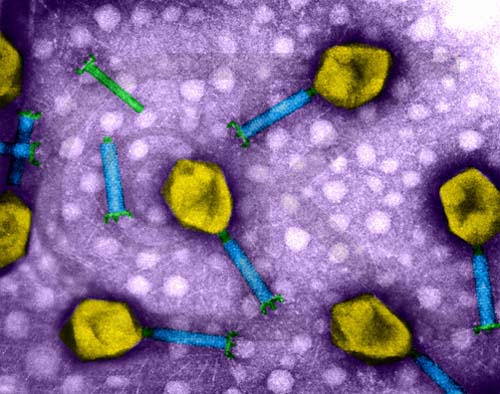
images, and look really cool too.  I also included a .jpg of a virus for
you to see.  It is a virus that infects bacteria, called a phage.  Yes,
bacteria can get viral infections too...  Viruses are so small that
hundreds of them can fit inside a single bacteria, and thousands of those
will fit on the tip of a pencil.  Good luck, and enjoy the images, I think
they are nifty  Thanks.

-Matt-
http://www.pbrc.hawaii.edu/~kunkel/gallery/no-frame.html
Try the links in the MadSci Library for more information on Cell Biology.