| MadSci Network: Environment |
Christine,
You picked a very interesting topic close to my heart. I have been to the Antarctic a few times now and can definitely tell you that icebergs, near Elephant Island or anywhere else in the Southern ocean DO NOT travel 150mph, or knots.
Perhaps the writer was confused. What does travel that fast at the latitude of Elephant Island is the geostrophic high altitude winds that whip around Antarctica at speeds up to 200+ mph in summer. These air currents thermally isolate the continent of Antarctica and it's surrounding waters (including the Circumantarctic Current from heat exchange with most of the rest of the planet.)
No need to worry, these high speed winds are typically the fastest at altitude where friction is minimal.
The actual speed of the water in which Southern Ocean icebergs move (the Circumantarctic Current) is on the order of only 0.25 - 0.45 cm/s or, just shy of 6 feet/hour.
Icebergs travel with a velocity even lower then that of the surrounding currents, although their speed is modified by various factors including below beam depth, vertical above beam profile, wind exposure, weathering and decay... etc.
It is quite common for icebergs the size of Conneticut to shelve off the Antarctic ice sheet. I recall circumnavigating an iceberg easily larger the Charleston SC for 4 days in our ship.
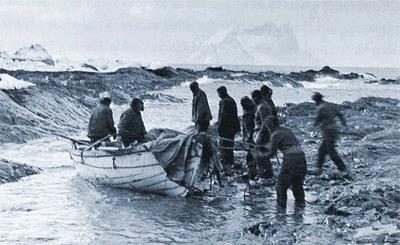
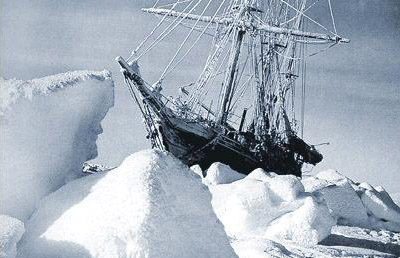
Interestingly, if you would like to learn more about Elephant Island, it was the wayover refuge for Sir Earnest Shackleton's crew who castaway after having their ship, the Endurance crushed by pack ice deep in the Antarctic ocean.
While a portion of Shackleton's crew waited out a rescue on Elephant Island, Shackleton and a few others struck out over 150 nautical miles to a remote whaling station South Georgia Island, navigating only by sighting the periodic sun through a storm tossed sea in what amounted to not much more then an improvised canoe. Upon arrival on South Georgia Island through all of their tribulations in the Antarctic, strandings on Elephant Island, and even a heart attack at sea, Shackleton et al landed on the wrong side of a rugged uncharted island.
They managed to hike nonstop across 22 miles of hostile glaciated terrain only to arrive in the whaling station by walking through a waterfall. Upon which they promptly returned to Elephant Island to rescue their mates. Amazingly, not one soul was lost.
Today, most Antarctic explorers complain if they cannot get e-mail or if
the shipboard hot-tub is in disarray.
Try the links in the MadSci Library for more information on Environment .