|
Genes consist of two functionally distinct components. There are regulatory sites ("reg. sites") that bind specific proteins (known generically as 'transcription factors'). The combination of transcription factors bound to a gene's regulatory sites will determine whether the gene will be recognized by DNA-dependent RNA polymerase. |
 reg.sites .............coding region |
| RNA polymerase makes an mRNA copy of the gene's "coding region", which is generally translated into a polypeptide. |
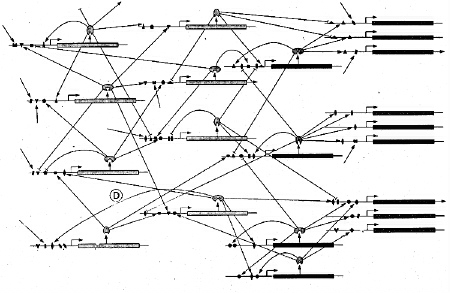
Signals from outside the cell (the arrows on the left of the figure) interact with cellular receptors and lead to changes in transcription factor activities).
input
output
Some of the genes expressed in response to external factors make transcription factors, or lead to altered transcription factor activity.
This leads to a global change in gene expression within the target cell (the output or target genes are shown on the right side of the figure).