MadSci Network: Environment & Ecology
Query:

Re: Experiments that explain why fish float

Date: Tue Nov 18 11:07:34 2003
Posted By: Mike Klymkowsky, Professor
Area of science: Environment & Ecology
ID: 1068720529.En
Message:

How do fish float

First it is important to realize that different species of fish have evolved to occupy different ecological niches, that is where they live and reproduce, what they feed on and what feeds on them.

In their three-dimensional world, they must use energy to 'place' and maintain themselves in the correct environment. There are two basic mechanisms by which fish determine whether they are ...

They can alter their density relative to water or they can fly through the water.


A body denser than water will sink down, a body less dense than water will float up.

The density of the body can be controlled in two ways. The first is through its overall composition. Certain tissues are inherently denser than water- bone and muscle for example, because they contain proteins. Other tissues, such as oils and fat, are less dense than water.

You could produce an experiment that explores which floats and which sinks in fresh and salt water (butter versus bone).

The overall composition of a body cannot be changed rapidly, so other more active mechanisms are often necessary.

In fish with a gas or swim bladder, the overall density of the body can be changed by either increasing or decreasing the volume of the bladder.

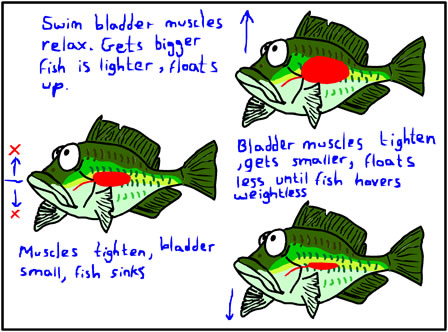
 

This is because gases, unlike most liquids (including water) are quite compressible.

This behavior is well illustrated by the Cartesian Diver and there are many on-line and virtual examples of this system.

The evolutionary origins of lungs and swim bladders are related.


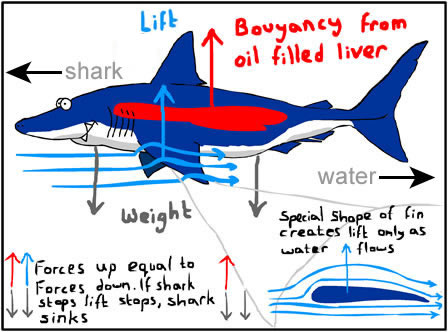
The other method to control where you are in the water is the same as that used by airplanes to determine where they are in the air, that is to use fins and forward movement to create lift.

This is the Bernoulli effect and it is easy to demonstrated using a piece of paper and a source of wind.


Current Queue | Current Queue for Environment & Ecology | Environment & Ecology archives

Try the links in the MadSci Library for more information on Environment & Ecology.


MadSci Home | Information | Search | Random Knowledge Generator | MadSci Archives | Mad Library | MAD Labs | MAD FAQs | Ask a ? | Join Us! | Help Support MadSci


MadSci Network, webadmin@www.madsci.org
© 1995-2003. All rights reserved.