| MadSci Network: Development |
![]() |
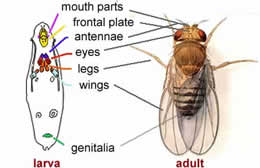
In holometabolous insects, such as flies, moths and butterflies, the fertilized egg produces a larval form that is distinctly different from the sexually mature adult. In the case of moths and butterflies, larvae are known as caterpillars; in flies and other insects they are referred to as maggots or grubs. |
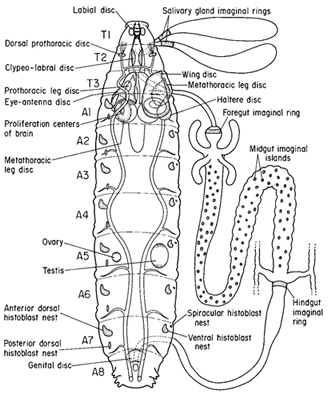
After a period of growth, during which a larva can increase in mass up to 10,000-times, it undergoes a process of metamorphosis to produce the adult. During the period of larval growth, groups of cells known as imaginal discs and histoblasts, are set aside. Upon metamorphosis most the larval cells are recycled through a process known as programmed cell death or apoptosis. The cells of the imaginal discs and the histoblasts, however, survive, divide and differentiate to form the adult. Note: Not all insects undergo such a drastic transformation. |
Try the links in the MadSci Library for more information on Development.