| MadSci Network: Science History |
It was about a hundred years ago when people first began to find out about protons and electrons. For a start they suspected (but did not really know) that the difference between different chemical elements was because of different numbers or different arrangements of protons and electrons in their atoms. They knew that hydrogen was special, because it had an atomic weight very much smaller than any other element. Lithium, the next lightest known element, had an atom about 7 times heavier than hydrogen, and even when helium was discovered at about this time, its atom was still 4 times heavier than a hydrogen atom. This lightness of hydrogen, together with the fact that its spectrum -- the pattern of colours of light that it gives out -- had only a few lines in a very simple pattern, helped people to decide that hydrogen had only one electron and one proton. But after that they were stuck. Helium was 4 times as heavy as hydrogen -- did this mean that it had 4 protons and 4 electrons?. Maybe, but then what about chlorine, which was 35.5 times as heavy as hydrogen. It could not have half a proton or half an electron!
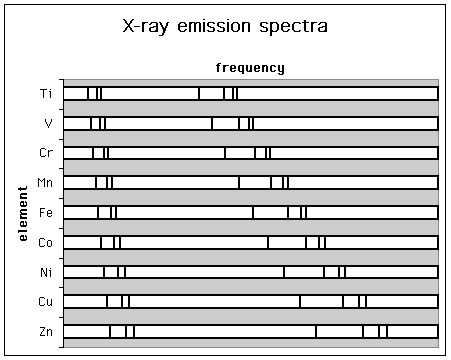
In 1913, an English physicist, Henry Moseley, measured the wavelengths of the X-rays emitted by various metals. When he arranged the metals in the order of atomic weights (nearly) he noticed a remarkably regular pattern.
I said "nearly" for the order of atomic weights for a reason. Chemists had been using the order of atomic weights to make patterns in the chemical properties of the different elements since around 1870. This was the periodic table. But to make the order right to give the patterns of chemical properties, they had to reverse the order of cobalt (Co) and nickel (Ni). Originally they had thought that something was wrong with the atomic weight measurements, and that cobalt, which kept coming out just a little heavier than nickel, was really lighter. But the atomic weight measurements kept stubbornly coming out the wrong way around. Well, when Moseley arranged his X-ray spectra of the various metals he found that he too had to reverse the order of cobalt and nickel. That is, they came in periodic table order, not in atomic weight order!
Moseley was able to work out that the pattern in his spectra fitted with
frequency = constant * (atomic number) ^2
where atomic number was a whole number that represented the number of
protons and electrons in the metal atom.
Shortly after this, Moseley interrupted his research to join the army when the First World War started in 1914. He died at the battle of Gallipoli in 1915 at the age of 28.
Try the links in the MadSci Library for more information on Science History.