| MadSci Network: Physics |
Let's say the front wheels have a radius of Rf, while the back
wheels have a radius of Rb. If the tractor is going in a
straight line at a linear (ground) speed v then the angular speed of the
front wheels is
wf = v / Rf
and the angular speed of the back wheels is
wb = v / Rb
so if Rf < Rb then the angular speed of the front
wheels is greater than that of the back wheels.
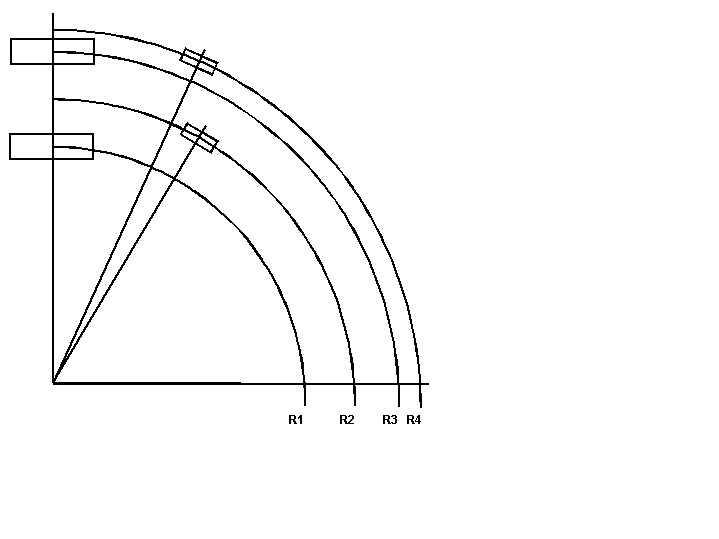
Below is a picture of a top view of a tractor that is in a turn.
The smaller rectangles represent the smaller front wheels, while the larger rectangles represent the larger back wheels. It is obvious that the linear (ground) speed of each of the four wheels is different because while in the turn the turn radius is different for each wheel, those radii being represented by the arcs R1, R2, R3, and R4.
We can
say that the angular speed of the center of the tractor in the turn is roughly
wc = vc /
Ravg
where vc is the linear (ground) speed of
the center of the tractor through the turn and Ravg is the average
radius of
the arcs R1 through R4. Note that this angular speed is qualitatively
different
than the angular speed of each of the wheels, because this is the turn
angular
speed of the tractor in the top view.
Now that we have the tractor's turn angular speed
wc we can calculate the angular
speed of each of the four wheels. Since the linear (ground) speed of each
wheel is
vn = wc *
Rn
where Rn is one of the turn radii R1 through R4, then the
angular speed of the "nth" wheel is
wn = vn /
Rf
for the front wheels and
wn = vn /
Rb
for the back wheels.
Therefore
w1 = w
c * R1 / Rb (the righthand back wheel)
w2 = w
c * R2 / Rf (the righthand front wheel)
w3 = w
c * R3 / Rb (the lefthand back wheel)
w4 = w
c * R4 / Rf (the lefthand front wheel)
The only way one of the back wheels can turn with larger angular speed than one of the front wheels is if the ratio R3 / Rb is larger than the ratio R2 / Rf. I am here talking about only these particular wheels because R2 is smaller than R4 and R3 is larger than R1, so I am here considering only the slowest-turning front wheel and the fastest-turning back wheel.
This depends not only on the relative sizes of the front and back wheels, but also on how tight the turn is. Other factors affecting the details for a particular tractor are the distance between the front and back axles, the separation of the front wheels, the separation of the back wheels, and things like whether or not the drive axle has a differential.
John Link, MadSci Physicist
Try the links in the MadSci Library for more information on Physics.