| MadSci Network: Engineering |
Hi Jacob,
Unfortunately, building a good surface electromygraphy (EMG) unit is no simple t ask because the signal is small compared to the noise present in the human body and the amplification circuitry.
Basically muscle contraction is the result of current in the muscle fibers. The current creates a voltage difference along the length of a fiber and the detection electrode (really it is two contact points) reads the voltage difference at two points along the conduction pathway (length of the fib er). The signal is weak (on the order 10 mV) and not very predictable. Often, the noise in the electronics is of the same order of magnitude as the signal.
You may need some help getting some of the necessary equipment. A physics teach er at your school may have a voltmeter that you can borrow, but it likely will not be sensitive enough for this project. You co uld try wiring yourself to an oscilloscope but you will likely pick up static generated signal and not true muscle use voltages . But before you give up, give it a try (safely). For example, maybe you have access to the guts of a public address system... If you remove the sound transducers on the microphone and speaker end, you have a really nice amplifier circuit in between. The microphone transducer takes the s ound waves and converts them to electric signal and the reverse happens on the speaker end where electric signal is converted to a speaker. Maybe, substitute the signal from the muscle for the microphone end and substitute an oscilloscope for the speaker. Will this work? Maybe. Depends on the amplifiers response to the frequencies expected for EMG. It is worth trying if tearing apart a PA system will not upset someone else :)
An excellent source for general information is given at http://www.delsys.com/emg_articles/EMG.shtml.
I found it to be very useful when I wrote this answer. It has some basic inform ation that will guide you in your construction of a "home built" surface EMG unit. I have reproduced and added to 3 parts of the Delsys explanation of the signal d etection system and system concerns that would apply to a "homebuilt" EMG unit.
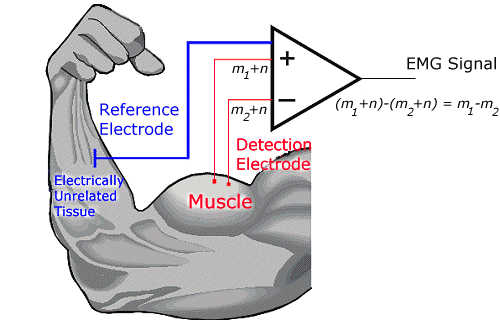
Differential amplification - In order to eliminate the potentially much greater noise signal from power line sources, a differential detecti ng configuration is employed. The differential amplification technique is shown schematically in Figure 2. The premise is simple. The signal i s detected at two sites, electronics circuitry subtracts the two signa ls and then amplifies the difference. As a result, any signal that is "comm on" to both detection sites will be removed and signals that are different at the two sites will have a "differential" that will be amplified. Any sig nal that originates far away from the detection sites will appear as a c ommon signal, whereas signals in the immediate vicinity of the detection surfaces will be different and consequently will be amplified. Thus, relatively distant power lines noise signals will be removed and relatively local EMG signals will be amplified. This explanation requires the availability of a highly accurate "subtractor". In prac tice, even with the wondrous electronics of today, it is very difficult to subtract signals perfectly. The accuracy with which the differential amplifier can subtract the signals is measured by the Common Mode Rejection Ratio (CMRR). A perfect subtractor would have a CMRR of infinity. A CMRR of 32,000 or 90 dB is generally sufficient to suppr ess extraneous electrical noises. Current technology allows for a CMRR o f 120 dB, but there are at least three reasons for not pushing the CMR R to the limit: 1) Such devices are expensive. 2) They are difficult to m aintain electrically stable, and 3) the extraneous noise signals may not arr ive at the two detection surfaces in phase, and hence they are not common mode signals in the absolute sense.
One of most difficult problems to overcome arises from the variability of the sk in's impedence. The resistance of skin changes considerably based on how wet or sweaty it is. Often, conductive gels are apllied to the skin in the electrode will be placedwill be placed. The gel will improve the "contact" of the skin to the electrode, which really means it will lower the effective impedence of th e skin-to-electrode interface.
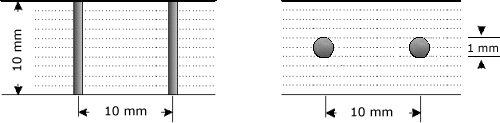
Below is a schematic of the two usual configurations for electrodes. Your electrodes will look like this, but will likely need to be bigger. To pull in more fibers and thus more signal. The presence electric current causes potential difference that you measure betwe en the two terminals of the electrode. The electrode must be placed with the contact points (terminals) along the lengt h of the conducting fibers. Parallel fibers can be measured to increase the signal strength and the two reading point s can be moved farther apart. The farther the two reading points are from each other the bigger the signal, provided they are still both in line with the conduction pathway. Including par allel fibers is helpful, provided that the parallel fibers included are also part of the desired signal. If the parallel f ibers are doing something else, then they will just add confusion and noise to the measurement.
Finally, safety! Anytime people and electronics are put together there is a possibility for electric shock. Please be careful.
Electrical safety concerns The failure of any electrical instrumentation making direct or indirect galvanic contact with the skin can cause a potentially harmful fault current to p ass through the skin of the subject. This concern is less relevant in device s that are powered exclusively by low voltage (3-15 V) batteries. To ensure safety, the subject should be electrically isolated from any electrical connection ( to the power line or ground) associated with the power source. This isolation i s generally achieved in one of two ways: either through the use of optical isolators or through the use of isolation transformers. Both approaches are satisfactory, but both require careful consideration for not distorting the EMG signal. This is especially true when a transformer is used.
This isolation provides the added benefit of reducing the amount of radi ated power line noise at the electrode detection surfaces.
http://www.execpc.com/~biores/bioemg.htm
http://www.idiom.com/~drjohn/emg.html
http://www.delsys.com/delsys.html
Sincerely,
Tom "Tennis Elbow" Cull
Try the links in the MadSci Library for more information on Engineering.