| MadSci Network: Earth Sciences |
The South Atlantic Anomaly is a real effect which occurs above Brazil, but it is very different from the effect known as the aurora.
The former occurs because Earth's magnetic poles aren't exactly opposite each other (in contrast to the geographic north and south poles). This means that there is one region on Earth (near Brazil) which is located furthest from BOTH magnetic poles. This means that the Van Allen Belts make their closest approach to the Earth above this point, dipping down from 700 miles to within 120 miles. This has implications for spacecraft in this area (the Hubble telescope is constantly dealing with a higher radiation background above Brazil), but it doesn't produce any auroras.
To understand why not, you have to know what causes an aurora. Near the magnetic poles, the Earth's magnetic field lines come back through the atmosphere, and energetic charged particles (from the sun) travel down these field lines and smash into the atmosphere. The result is a colorful display.
But the South Atlantic Anomaly does not involve magnetic field lines coming down through the atmosphere; instead the Van Allen Belts are simply belts of charged particles, and they stay well above the atmosphere, so you'll rarely see any auroras in Brazil.
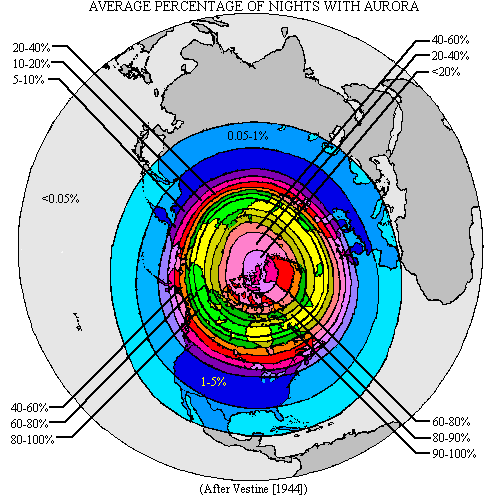
How rarely? Below is a map showing the probability of seeing an aurora on a given night. The furthest-from-the-magnetic-pole sighting I've heard of was in the Bahamas, but presumably rare solar storms can cause an aurora even further south. Brazil would actually be the least-likely place in the world to see an aurora, because (as I said above) it's furthest from BOTH magnetic poles. Even if an aurora was observed there once or twice (which I couldn't find documented anywhere), the error bar on the probability would still be huge -- so don't expect to see an aurora exactly once every 27 years!
Try the links in the MadSci Library for more information on Earth Sciences.