| MadSci Network: Physics |
I imagine everyone who has walked in their lifetime has tripped and has fallen. The human body's ability to maintain balance is extraordinary. Balance is a combination of experience, muscle strength, flexibility, and proprioception. Maintaining balance is achieved by small manipulations by the muscles of the body to balance torques and forces produced by gravity. Kenneth Law and Cynthia Harvey discuss balance as chapter 2 in their book Physics, Dance, and the Pas de Deux (I don't know how readily available this book is, but it is a great reference for balance and spin as these concepts relate to human efforts).
I recommend looking at a high school level physics text for information on mechanical equilibrium (or statics) if you are not familiar with it already. The basic concept is that a body will not accelerate if all the forces are balanced, and the same body will not rotate if all the torques are balanced. Usually a force diagram will help to visualize the process.
When a person trips and falls, the body cannot generate enough torque to keep from rotating to the ground. The center of mass of the body, or body components must lie within the base of support to balance the torque. I will not go into numerical detail here. Let's look at a simple example to get the concepts.
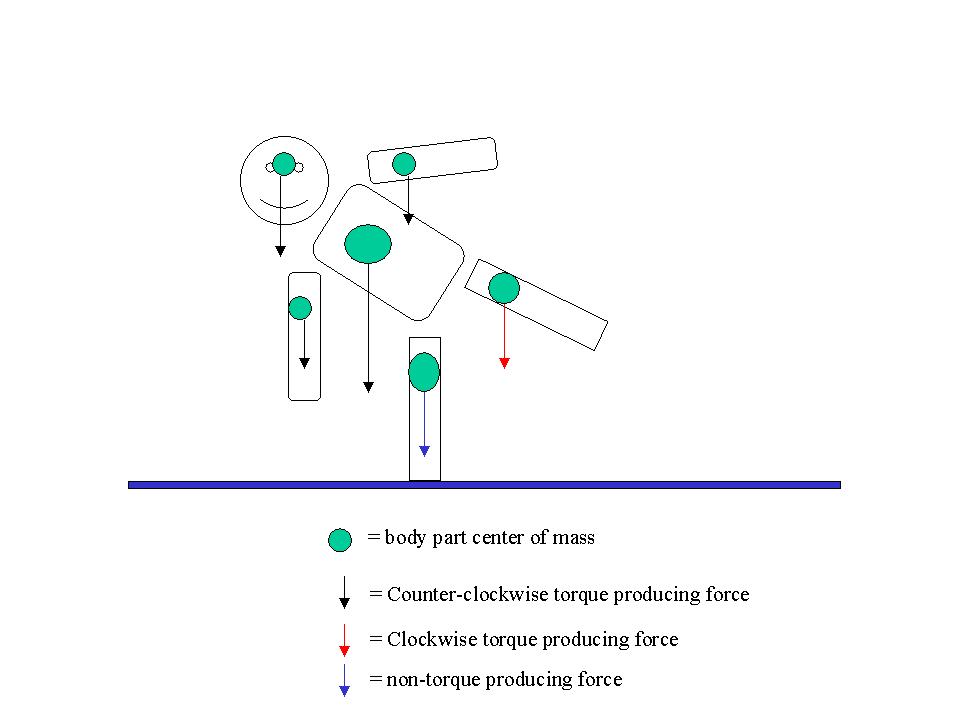
A simple way to think about it is to envision the human body as made up of rigid components attached with joints or pivots. Some of these pivots can rotate in multiple directions (i.e. twist and bend), while others just bend. For example, the head is attached to the body with the "neck pivot" and the body is connected to the legs through the "waist pivot." Both of these can bend and twist. While the "elbow pivot" just bends. Each part of the body has a mass and a center of mass. The force of gravity is down (vertical) and acts through the point of the center of mass of each body part. The torque produced is the force of gravity (weight) times the horizontal distance between the center of mass and the pivot. Here is a force diagram cartoon of a poor guy that is going to fall.
Let's suppose that our person trips by catching a toe while walking and the foot does not land where expected. The upper body keeps moving forward and the "waist pivot" bends and probably twists relative to the legs. Suddenly there is an unbalanced torque. To correct this, the person can use their arms to redistribute her weight (the classic arm waving or jiggling to stop from falling). The arms will pivot around the body through the shoulders to redistribute the weight. However, if the torque is too great, or the balance correction is wrong the person will rotate toward the ground. There is a critical point beyond which the torque is too great for the muscles and contortion of the body to overcome. WHAM!!! Our person hits the floor.
The interesting thing to me is the variability in people's ability to maintain or manipulate their balance. For example, I cannot skate, skateboard, or flip and land on a balance beam, but as a kid, I used to ride a bicycle "no- handed" with expert skill. Balance can also by compromised by dizziness, which affects the sense of proprioception. This causes a person to reach improperly when attempting to correct lack of balance.
Also you may want to check out previous MadSci answers (MadSci Search) that discuss elements of balance or balancing and countering the effects of gravity:
How do you keep your balance? (answer from an anatomy point of view!)
Re: What are some concepts of physics involved in the sport of gymnastics? (Physics, Dance, and the Pas de Deux )
Re: What physic's are involved in trampolining
Re: How does acceleration and speed affect track runners?
Why do taller things balance easier than shorter things?
Why is it easier to balance on my Laser Scooter when moving?
Ho w do your eyes affect balance?
Sincerely,
Tom "Down goes Frazier! Down goes Frazier" Cull
Try the links in the MadSci Library for more information on Physics.